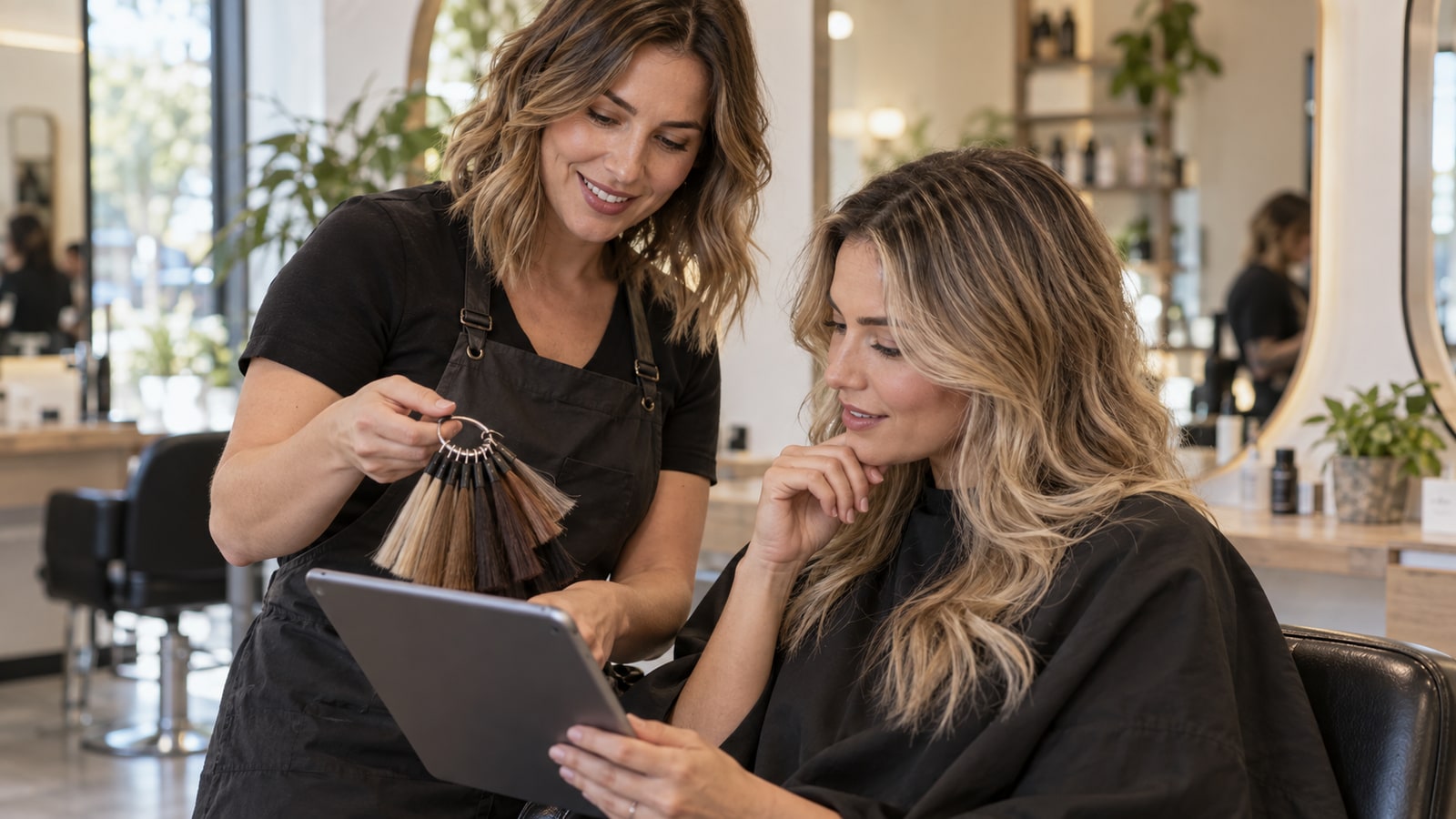
Why Stylists Love (and Hate) Smartphone Photos
A photo is useful when you can say, “I like this depth, this coolness, and the soft transition at the roots.” It lets a colorist see your preferred direction more clearly than a shade name alone. Bring the original inspiration image and any virtual preview, ideally viewed on the same screen and in similar light.
A digital filter cannot reveal your prior dye, natural base, porosity, elasticity, or the number of sessions a change may require. Screen color and salon light can also differ. If you expect an exact match in a short appointment, the picture becomes less useful. Treat it as a visual brief and ask what part of the reference is achievable on your hair. The levels-and-tones guide can help you describe depth and reflect without assuming a formula.
The 4 Critical Questions to Ask Your Colorist
- “Can my hair reach this level of lift in one session without unacceptable breakage?” Ask what a safer staged version would look like if the target needs more lift than your hair can tolerate today.
- “What might this shade look like as it fades over four to eight weeks?” The answer depends on your base, formula, washing routine, and exposure to light; ask to see examples of the expected warmth or root contrast.
- “What is the monthly maintenance budget and toner schedule?” Request a realistic range for appointments and home care rather than assuming the initial price is the whole cost. The hair color maintenance guide explains grow-out options.
- “Could previous box dye or mineral buildup affect the formula?” Tell your colorist about all previous dye, lightener, glosses, henna, and relevant water or product exposure you know about, even if the color looks grown out.
Also ask which parts of the reference are about lighting, styling, or image editing. A colorist can propose a nearby color direction if the exact photo is not a practical target.
The Non-Negotiable In-Person Strand Test
A photo cannot test how a strand responds to lightener or color. For a major lift, a correction, or uncertain color history, ask your colorist whether a strand test is appropriate before committing to the full service. A small hidden section, often near the nape, can show how the hair lifts, which warmth appears, and how the treated fiber feels. The result guides a safer plan, but it does not guarantee identical behavior across the whole head.
A strand test checks color processing on hair. A patch test checks for a possible skin reaction to a dye product; they answer different questions. Follow the product instructions and your salon's patch-testing policy. The FDA's hair-dye safety guidance advises a patch test before dye use. Tell the colorist about past reactions and follow their safety instructions.
Copyable Salon Consultation Cheat Sheet
Copy these lines into a note and fill in what you know. “Not sure” is more useful than a guessed number.
My color direction: [two or three reference images and what I like in each]
Desired level or depth: [approximate, or not sure]
Desired tone or reflect: [cool / neutral / warm; ash / beige / gold / copper / other]
Budget: [initial visit range and follow-up range]
Maintenance tolerance: [how often I can return; how visible I am comfortable with roots becoming]
Past chemical history: [dates and types of dye, bleach, gloss, henna, straightening, or other known treatments]
Questions: [lift, fading, strand test, patch test, staged options]
If you used a virtual try-on, add which features you wanted to compare, such as a deeper root or warmer ends. It is a comparison aid, not a promise that your hair can reach the pictured result. For additional ideas, see how to choose a hair color.
Frequently Asked Questions
What should I do if my stylist says my dream color is impossible?
Ask which constraint matters: previous dye, hair condition, time, budget, or upkeep. A transitional balayage, gloss, or darker version of the target may capture the part you like now. If the issue is hair integrity, a staged plan and strand test are more useful than pressing for the photo in one visit.
Should I wash my hair right before a salon color appointment?
Ask your salon, because preparation depends on the service and products. Some colorists suggest washing a day or two beforehand; others may want hair free of heavy styling buildup. A fixed 24–48-hour rule does not replace the salon's instructions, and scalp oil is not a guarantee against irritation. Report any scalp discomfort before the service.